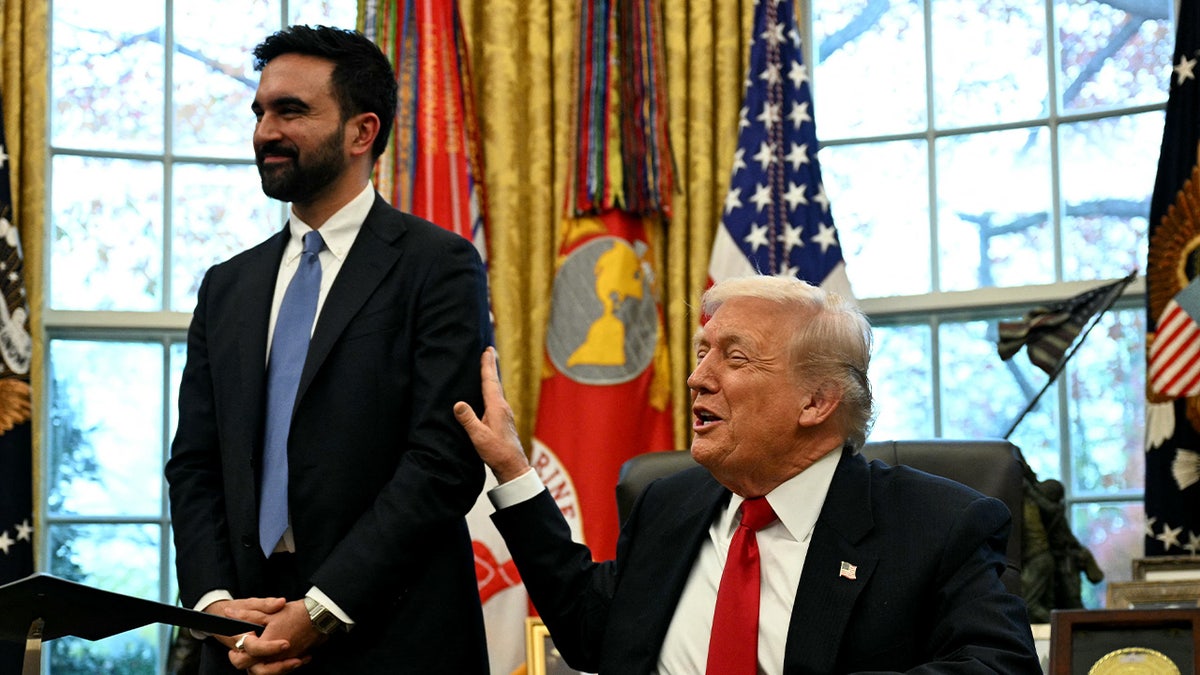
Starmer, Merz and Macron take phone call with Trump on Ukraine peace talks – Europe live | Europe


Key events

Jakub Krupa

Jakub Krupa

That’s all from me, Jakub Krupa, but Fran Lawther is here to guide you through the late afternoon.

The UK version of the statement after the E3 call with Trump is very similar, and it reads:

“The Prime Minister spoke to the President of the United States, Donald Trump, the President of France, Emmanuel Macron, and the Chancellor of Germany, Friedrich Merz today.

The leaders discussed the latest on the ongoing US-led peace talks, welcoming their efforts to achieve a just and lasting peace for Ukraine, and to see an end to the killing.

Intensive work on the peace plan is continuing and will continue in the coming days.

They agreed that this was a critical moment – for Ukraine, its people and for shared security across the Euro-Atlantic region.”

The French version is almost identical, too.

Share

Updated at 

Merz, Macron, Starmer spoke with Trump about Ukraine, Germany confirms

The German government’s statement on the call confirmed that chancellor Merz joined France’s Macron and UK’s Starmer on a phone call with US president Trump.

They discussed “the state of talks” on ending the Ukraine war, agreeing that “intensive work on the peace plan is to continue in the coming days.”

The leaders also agreed that it was “a crucial moment” for Ukraine and for “common security in the Euro-Atlantic area.”

Macron says he spoke with Trump, European leaders on Ukraine

France’s president Emmanuel Macron said he had held a phone call earlier on Wednesday US president Donald Trump to discuss the situation in Ukraine, Reuters reported.

“I was at the St Malo town hall for a phone call with some colleagues and President Trump on the question of Ukraine,” Macon said after arriving late at a public debate in the Brittany town on social media networks.

“We had about 40 minutes of discussion to advance on a subject that concerns all of us,” he said.

27 governments call for Europe’s human rights laws to be ‘constrained’

Rajeev Syal

Rajeev Syal

Home affairs editor

The UK has joined some of Europe’s hardline governments in calling for human rights laws to be “constrained” to allow Rwanda-style migration deals with third countries and more foreign criminals to be deported.

People thought to be migrants wait in the sea to board a small boat in Gravelines, France. Photograph: Gareth Fuller/PA

Twenty-seven of the 46 Council of Europe members including the UK, Hungary and Italy have signed an unofficial statement that also urges a new framework for the European convention of human rights, which will also narrow the definition of “inhuman and degrading treatment”.

The statement follows a meeting of the council in Strasbourg on Wednesday as part of a push to change the way the laws apply in migration cases.

France, Spain and Germany are among those countries that have declined to sign the statement, instead putting their names to a separate, official declaration backed by all 46 governments.

The two separate statements are signs of deep divisions across Europe over how to tackle irregular migration, and whether to continue to guarantee rights for refugees and economic migrants.

The letter signed by 27 countries said that article 3 of the convention, which bans “inhuman or degrading treatment” should be “constrained to the most serious issues in a manner which does not prevent states parties from taking proportionate decisions on the expulsion of foreign criminals … including in cases raising issues concerning healthcare and prison conditions”.

It also argues that article 8 of the convention should be “adjusted” in relation to criminals so that more weight is put on the nature and seriousness of the offence committed and less on a criminal’s ties with the host country.

The rest of the 27 signatories are: Denmark, Albania, Austria, Belgium, Bulgaria, Croatia, the Czech Republic, Estonia, Finland, Iceland, Ireland, Latvia, Lithuania, Malta, Montenegro, the Netherlands, Norway, Poland, Romania, San Marino, Serbia, Slovakia, Sweden and Ukraine.

Italy first country to win Unesco recognition for national cuisine

Angela Giuffrida

Angela Giuffrida

in Rome

In other news, Unesco has officially recognised Italian cooking as a cultural beacon, an endorsement hailed by the far-right prime minister, Giorgia Meloni, whose government has put the country’s food at the heart of its nationalistic expression of identity.

A waiter shows a plate of traditional pasta Carbonara in front of the Pantheon in Rome, Italy. Photograph: Remo Casilli/Reuters

The announcement, made on Wednesday during the UN cultural body’s assembly in Delhi, means Italian cuisine – from pasta and mozzarella to wine and tiramisu – will be inscribed on the coveted list of “intangible cultural heritage”.

Italy already has 21 other traditions on the list, including the art of Neapolitan pizza making and opera singing, and it is the first country to be recognised for its cuisine in its entirety rather than for a single tradition or recipe.

In a video message posted on her Instagram account within minutes of the announcement, Meloni said the news filled her with pride.

“We are the first in the world to receive this recognition, which honours who we are and our identity,” she said. “For us Italians, cuisine is more than just food or a collection of recipes. It’s much more than that: it’s culture, tradition, work and wealth.”

EU proposes exempting AI gigafactories from environmental assessments

Ajit Niranjan

Ajit Niranjan

Europe environment correspondent

Datacentres, AI gigafactories and affordable housing may be exempt from mandatory environmental impact assessments in the EU under a proposal that advances the European Commission’s rollback of green rules.

The latest in a series of packages to cut red tape calls for permitting processes for critical projects to be sped up and reducing the scope of environmental reporting rules for businesses.

The proposed overhaul would expand the list of strategic sectors to count datacentres, in line with the EU’s ambitions to become a global leader in AI, and affordable housing, to improve labour mobility. Member states would be free to decide whether such projects should be subject to environmental impact assessments.

Other parts of the simplification plan include repealing a hazardous chemical database that lists “substances of concern in products”; removing requirements on EU polluters to have authorised representatives in member states where they sell their products; and pushing the need for environmental management systems in farms and industry from the level of plants to that of companies.

You can read the full report here:

Share

Updated at 

European leaders expected in Berlin for talks on Ukraine next week – reports

We have also had unconfirmed reports in the last half hour that another meeting of European leaders on Ukraine is planned for Monday in Berlin, a week on from the latest summit in London.

We will keep an eye on this and bring you the official confirmation if/when we get it.

Germany wants US to remain close partner despite changing nature of relationship, Merz says

Meanwhile, German chancellor Friedrich Merz said he wanted the US to remain a partner of Germany despite a changing nature of their relationship, saying he would also defend his country’s record on migration when he next meets Donald Trump.

“We are preparing ourselves for a change in transatlantic relations. But I would still like to see it as a partnership, and I hope that America sees it the same way in its relations with Europe and also with Germany,” Merz told reporters.

And that ends the Nobel prize ceremony in Oslo.

‘We will hug again, fall in love again, hear our streets fill with laughter and music,’ Machado’s promise for Venezuela

The speech ends with a simple, but deeply moving, promise:

Venezuela will breathe again.

We will open prison doors and watch thousands who were unjustly detained step into the warm sun, embraced at last by those who never stopped fighting for them.

We will see grandmothers settle children on their laps to tell them stories not of distant forefathers, but of their own parents’ courage.

We will see our students debate ideas passionately and without fear, their voices rising freely at last.

We will hug again. Fall in love again. Hear our streets fill with laughter and music.

All the simple joys the world takes for granted will be ours.”

She says:

“Because in the end, our journey towards freedom has always lived inside us.

We are returning to ourselves. We are returning home.

Ana Corina gets a standing ovation for delivering her mother’s lecture.

Ana Corina Sosa, daughter of Venezuelan opposition leader Maria Corina Machado, speaks after receiving the Nobel Peace Prize for her mother at the Nobel Peace Prize ceremony at Oslo City Hall in Oslo, Norway. Photograph: Odd Andersen/AFP/Getty Images

María Corina Machado warns against taking democracy for granted

María Corina Machado’s daughter now reads her Nobel peace prize lecture.

It begins:

“I have come here to tell you a story: the story of a people and their long march toward freedom.

This march brings me here today as one voice among millions of Venezuelans who rose, once again, to reclaim the destiny that was always theirs.

Venezuela was born of audacity, shaped by peoples and cultures intertwined. From Spain we inherited a language, a culture, and a faith that merged with ancestral Indigenous and African roots.”

It’s a moving, personal story of what happens when democracy is taken for granted, as “even the strongest democracy weakens when its citizens forget that freedom is not something we wait for, but something we become.”

In what can sound like a warning for many, she says:

My generation was born in a vibrant democracy, and we took it for granted. We assumed freedom was as permanent as the air we breathed. We cherished our rights, but we forgot our duties.

By the time we recognised how fragile our institutions had become, a man who had once led a military coup to overthrow the democracy, was elected president. Many thought charisma could substitute the rule of law. “

María Corina Machado expected in Oslo ‘in just few hours,’ daughter confirms

Just before delivering the lecture, Ana Corina Sosa Machado, confirms that her mother will be in Oslo “in just a few hours.”

She says:

And as I wait that moment to hug her, to kiss her, to embrace her, after two years, I think of the other daughters and sons who do not get to see their mothers.

Today, this is what drives her. What drives all of us. She wants to live in a free, Venezuela and she will never give up on that purpose.”

Ana Corina Sosa Machado, daughter of Nobel Peace Prize laureate Maria Corina Machado, accepts the award on behalf of her mother, during the Nobel Peace Prize award ceremony at Oslo City Hall, in Oslo. Photograph: Stian Lysberg Solum/Reuters

Ana Corina Sosa Machado, the daughter of Maria Corina, is now receiving the medal and the diploma for the 2025 Nobel peace prize.

She will also deliver a lecture, written by her mother.

‘Let new age dawn’ in Venezuela, Nobel committee chair says

Jørgen Watne Frydes ends on a strong note as he says that “freedom is drawing closer” in Venezuela, and says “let a new age dawn.”

He says:

Today, we honour Maria Corina Machado.

We pay tribute as well to all who wait in the dark.

All who have been arrested and tortured, or have disappeared.

All who continue to hope.

All those in Caracas and other cities of Venezuela who are forced to whisper the language of freedom.

May they hear us now.

May they realise that the world is not turning away.

That freedom is drawing closer.

And that Venezuela will become peaceful and democratic.

Let a new age dawn.

Chair of Nobel committee calls on Venezuela’s Maduro to step down

In a direct passage addressing Venezuela’s Nicolás Maduro, Jørgen Watne Frydnes, chair of the Norwegian Nobel Committee, calls on him to step down and accept the democratic result.

He says:

“Therefore, here today, in this hall – with all the gravity that attends the Nobel Peace Prize and this annual ceremony – we will say what authoritarian leaders fear most:

Your power is not permanent.

Your violence will not prevail over people who rise and resist.

Mr Maduro,

You should accept the election results and step down.

Lay the foundation for a peaceful transition to democracy.

Because that is the will of the Venezuelan people.

Maria Corina Machado and the Venezuelan opposition have lit a flame that no torture, no lie and no fear can extinguish.

When the history of our time is written, it won’t be the names of the authoritarian rulers that stand out – but the names of those who dared resist.”

Norwegian Nobel Committee’s chair also speaks about the current situation in Venezuela.

He says:

What are we all to think when we read that it is the Venezuelan opposition that’s threatening the country with war – that the democratic movement desires an invasion? When the narrative is turned upside down, and the victims are branded aggressors? This is the version of reality the Maduro regime tells the world: that it is the guarantor of peace. But peace based on fear, silence and torture – is no peace. It is submission, depicted as stability.

No, the source of the violence is not democracy activists. It is those at the top who refuse to cede power. It was not Nelson Mandela who made South Africa violent, but the apartheid regime’s crackdown on demands for equality. Opposition groups did not start the imprisonments in Belarus, the executions in Iran – or the persecution in Venezuela. The violence comes from authoritarian regimes, as they lash out against popular calls for change.”

Share

Updated at 

Nobel’s Jørgen Watne Frydnes also pointedly criticises the world for not paying attention to the events in Venezuela, saying that attitude amounts to “the moral betrayal of those who actually live under this brutal regime.”

He says:

And when the Venezuelans asked the world to pay attention – we turned away.

As they lost their rights, their food, their health and safety – and eventually their own futures – much of the world stuck to old narratives.

Some insisted Venezuela was an ideal egalitarian society. Others wanted only to see a struggle against imperialism. Still others chose to interpret Venezuelan reality as a contest between superpowers, overlooking the bravery of those who seek freedom in their own country.

What all these observers have in common is this: the moral betrayal of those who actually live under this brutal regime.

If you only support people who share your political views, you have understood neither freedom nor democracy. Yet many critics stop there. They see local democratic forces cooperating, by necessity, with actors they dislike – and use that to justify withholding support. This puts ideological conviction ahead of human solidarity.

It is easy to stand on principle when someone else’s freedom is at stake. But no democracy movement operates in ideal circumstances. Activist leaders must confront and resolve dilemmas that we onlookers are free to ignore. People living under dictatorship often have to choose between the difficult and the impossible.

Yet many of us – from a safe distance – expect Venezuela’s democratic leaders to pursue their aims with a moral purity their opponents never display. This is unrealistic. It is unfair. And it shows ignorance of history.”

He draws similarities with previous Nobel peace prize winners, South Africa’s Nelson Mandela and Poland’s Lech Wałęsa.


Source link

Leave a Reply

Your email address will not be published. Required fields are marked *