How Trump Could Help the People of Iran
Marching alongside a column of protesters through the city of Borujerd in western Iran, a middle-aged woman appeared unperturbed by the blood streaming down her chin. “I am not afraid,” she called out in a video clip posted by Iran International. “I have been dead for 47 years.”
She spoke for many in the crowds of protesters now thronging Iran’s streets. As the Islamic Republic convulses with demonstrations across all 31 provinces, Iranians of all ages are catching a glimpse of national rebirth after nearly half a century of theocratic rule.
Periodic mass protests have marked Iranian life for nearly two decades—the Green Movement of 2009; the fuel protests of 2019; the Women, Life, Freedom uprising of 2022–23. Each wave was brutally repressed. But never before has the Islamic Republic been so weakened at home and so vulnerable to pressure from abroad. The possibility of overthrowing Supreme Leader Ayatollah Ali Khamenei’s regime is no longer theoretical.
[Arash Azizi: Change may be coming to Iran]
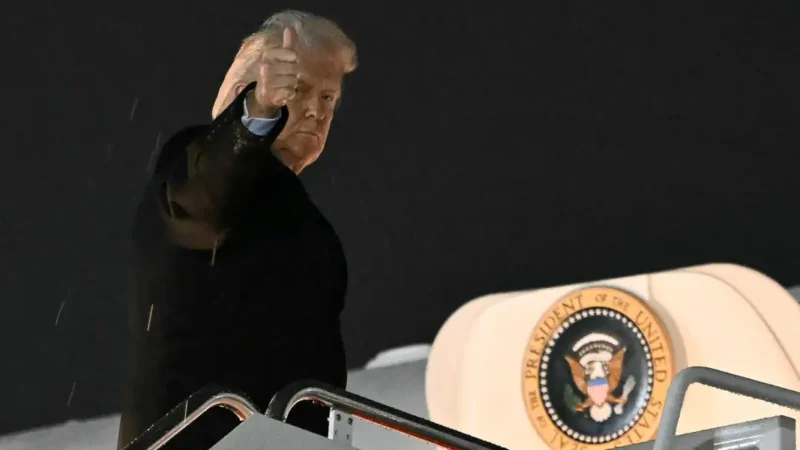
For President Trump, these protests present a historic opportunity to cement his legacy as the Ronald Reagan of his era. Reagan did not collapse the Soviet Union through military force. He did it by applying overwhelming economic, ideological, and proxy pressure from the outside—while supporting dissidents on the inside. Trump can do the same with the Islamic Republic.
Over the course of his two terms, Trump has attacked the regime’s foundations through robust sanctions, diplomatic pressure, and—by joining the final stage of Israeli strikes against Iranian nuclear facilities last June—military action. As a result, the Islamic Republic is weaker today than at any point since its founding, in 1979. Yet it would be foolhardy to believe that the regime’s decline is irreversible. The ayatollahs will not go quietly. They will resort to bloodshed against a mostly unarmed population, as they have since 2009. Trump is uniquely positioned to make the difference between the regime surviving or its joining the Soviet Union on what Reagan called the “ash heap of history.”
Trump’s established policy of maximum pressure—targeting Iran’s nuclear program, missile development, and regional terror proxies—now needs to be combined with maximum support for the protests. With millions in the streets, the objective of regime change is suddenly achievable, without the invasions and occupations that defined America’s wars in Iraq and Afghanistan.
How would this work? In the spirit of the Hippocratic oath, first do no harm. Trump should discipline his rhetoric, avoiding terms such as riots and stampedes that echo regime propaganda. And because he has already learned that the regime uses negotiations only to buy time and divide the West, he should flatly reject any pleas from Tehran to resume nuclear talks.
Trump has openly admired the Iranian people’s “enthusiasm to overturn that regime” and warned the ayatollahs that the United States remains “locked and loaded” if they resort to massacre. This strategic messaging matters. It reminds protesters that the regime is not omnipotent—especially after its poor performance in June’s 12-Day War with Israel and the U.S., and its failure to address Iran’s economic collapse and deepening water and environmental crises.
Trump can also highlight individual acts of bravery, naming protesters in interviews and speeches, and sharing videos on social media. The State Department’s Persian-language accounts are valuable amplifiers, but they are no substitute for presidential leadership.
At the same time, the administration must name, shame, and sanction human-rights violators at every level of the regime’s repressive apparatus. In particular, it should fully enforce sanctions authorized by the bipartisan MAHSA Act, passed after the murder of Mahsa Amini, which sparked the Women, Life, Freedom protests.
Iran’s energy sector—the regime’s financial lifeline—can and must be squeezed further. Because of the lack of sanctions enforcement for four years under the Biden administration, Iranian oil exports remain near 2 million barrels a day, far above the Trump administration’s stated goal of 100,000 barrels. The regime should not be permitted to sell oil illicitly to fund repression. Deploying the U.S. Navy to seize Iranian oil tankers—as the administration has already done with Venezuela—is necessary. Sanctioning Chinese banks facilitating these purchases is essential. Every dollar denied means fewer resources for the regime’s security forces.
With foreign journalists barred, social media is the protest movement’s lifeline. Predictably, the regime has imposed a nationwide internet blackout to isolate demonstrators and conceal atrocities. The United States should work with private-sector partners to ensure free and secure communications, flooding the country with Starlink terminals and expanding access to free VPNs. If Iranians cannot communicate, they cannot mobilize, coordinate, or expose the regime’s crimes.
Trump should also press U.S. allies to do more. The European Union has sanctioned individual Islamic Revolutionary Guard Corps members but not the IRGC itself—the regime’s dark heart, enriched by Iran’s energy sector, ports, infrastructure, and banks. Western capitals should also reconsider allowing Iranian embassies to remain open despite clear evidence of regime-linked terror plots in Germany, the United Kingdom, Sweden, and Australia as well as the United States. These diplomatic ties should be severed.
Finally, Trump can hasten internal collapse by weakening the regime from within. He can offer incentives for defectors. He can authorize targeted cyber and covert operations against instruments of repression such as the Basij, cyber police, and morality police, as Israel demonstrated last June. He can conduct influence operations to deepen fractures among regime supporters losing faith. And if necessary, he can act in real time, striking security convoys moving to crush protests and denying the regime control over its own streets.
[Tom Nichols: Trump’s ‘Operation Iranian Freedom’]
None of this requires occupation or nation building. It requires precision intelligence, covert action, and close cooperation between the CIA and Israel’s Mossad—capabilities already proven inside Iran.
The overthrow of the Islamic Republic would rank among the most consequential foreign-policy achievements of the 21st century. A free Iran would transform the Middle East, dismantle the world’s leading state sponsor of terrorism, and restore a proud, pro-American nation to its rightful place as a force for stability and prosperity.
Trump recently told The New York Times that the only constraint on his power is “my own morality, my own mind.” If so, he has a unique chance to act—but his window of opportunity is closing fast.
Mark Dubowitz is the CEO of the Foundation for Defense of Democracies. Behnam Ben Taleblu is the senior director of FDD’s Iran program. The views expressed are their own.