The Dead Are Not Off-Limits for Trump
When Rob Reiner died violently alongside his wife, Michele Singer Reiner, yesterday, a familiar thing happened in American public life: a window opened.
It opened not because Reiner, a vocal liberal, was universally beloved or politically neutral, but because his work occupied shared cultural space. The National Review writer Jeffrey Blehar quoted Mary Katherine Ham, another conservative writer, in an article lauding the director and actor: Reiner was a “VHS King”—a filmmaker whose movies fused themselves to childhoods, relationships, and formative memories. The Princess Bride, Stand by Me, When Harry Met Sally—even people who disagreed with Reiner’s politics had lived inside worlds he helped create. His death therefore moved beyond private tragedy into collective recognition about a set of shared reference points. That is what opens the window: common memory, common shock, common vulnerability.
When the country confronts something as horrible as the Reiners’ killing, it is destabilizing. When the victim is someone we feel we knew or whose work helped us know ourselves, the moment may be more so. These breaches present leaders with an opportunity to stay quiet. Let the poets and the priests and rabbis take over. Leave room for the fan whose perfect tribute captures the nation. If the leader can’t help but comment, the best they can offer is containment. In crisis psychology, people calm when they sense boundaries around chaos. In today’s world, what that looks like is a leader who acknowledges grief even if it’s not their own, or who affirms that all is not chaos when a major rupture happens.
During a weekend that also included a deadly shooting at Brown University and a massacre at a Hanukkah celebration in Australia, the country was already shaken. Containment was needed more than ever.
[Read: Trump blames Rob Reiner for his own murder]
What was not called for—in the moment, in the psychology handbook, or in the traditions of the American presidency—was Donald Trump’s response.
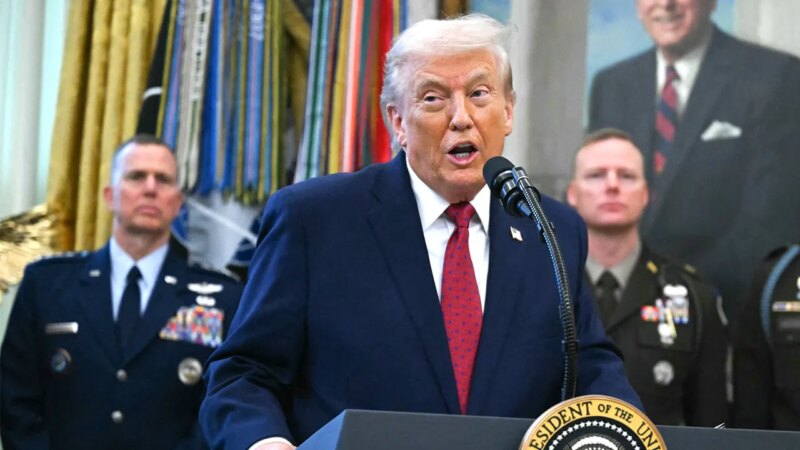
On Truth Social today, the president mocked Reiner, suggesting that his death was the result of “Trump Derangement Syndrome”—a “mind-crippling disease,” he called it, suggesting, obviously without evidence, that Reiner’s criticism of Trump had invited his death. Trump did something worse than mock. He blamed a murdered man for his own murder, while the Reiners’ own son sits in custody on suspicion of killing them. Trump used a family tragedy against a dead man. This was not merely irresponsible, nor simply another example of norm-breaking rhetoric. It actively widened the breach. He didn’t affirm human boundaries; he punctured them to display dominance. Grief became a plaything. Shock became his permission.
It was not just what Trump said, but what he refused to do. Presidents have unique tools. They can slow the emotional spin of events. They can affirm shared moral grammar: that the dead are off-limits, that suffering warrants restraint, that power bows—briefly—to loss, that no act by a political foe can erase those truths, that leaders uphold standards. Trump used none of those tools.
[Read: Rob Reiner was a quiet titan of storytelling]
Trump’s defenders often describe him as a “daddy” figure—strong, unconcerned with elite expectations. Accept that framing, and Trump’s failure in this moment becomes larger, not smaller. In times of shock, a parent does not mock the wounded or ridicule the dead. A parent steadies. A parent signals safety, a backstop. Trump instead signaled that nothing is protected, and no shared floor exists.
Compare Trump’s reaction with Erika Kirk’s in her own moment of grief. After her husband, Charlie Kirk, was murdered earlier this year, she publicly forgave the alleged assassin. She could have reacted as Trump did today. She had more cause. She was not a public figure of whom a certain standard is expected. An outburst against the killer would have been natural and understandable from the victim’s wife. She did the opposite, which lifted those watching, and did honor to her Christianity, her husband, and anyone who admires character under stress. It suggested that discipline—of faith, love, character, whatever you like—could start to put a boundary around madness.
That is the final measure. In moments when the country looks up for orientation, Trump does not steady the room. He destabilizes it. He does not merely break norms; he erodes the conditions that make shared meaning possible. Where Reiner built a national cultural space—worlds we could all inhabit together—Trump dissolves it. He takes the scaffolding we’ve constructed and sets it on fire.