Trump’s Crypto Defenses Aren’t Reassuring
The royal family in Abu Dhabi had a problem. Their AI firm, G42, wanted American chips, but both the Biden administration and Republicans in Congress feared letting them have any out of concern that the chips would be transferred to China.
The family solved the problem last year, The Wall Street Journal has discovered, by using the simplest solution that businesses can now employ for a policy obstacle: They seem to have made a deal with the Trump family. Sheikh Tahnoon bin Zayed Al Nahyan, a member of the Abu Dhabi royal family sometimes called the “Spy Sheikh,” purchased a 49 percent share in World Liberty Financial, the Trump family’s crypto firm, thus sending $187 million to Trump-family-controlled entities. That spring, the Trump administration reversed American policy and approved the AI-chip transfer.
A sitting U.S. president shouldn’t have a business partner. If he did, ideally, that partner would be a U.S. citizen and not an agent of a foreign government. But if the president is going to have a foreign operative as his business partner, ideally that partner would not have a nickname like the Spy Sheikh.
President Trump has generally managed to confine the proliferating conflicts between his business dealings and the public interest to second-tier news stories. Trump and his spokespeople have rarely had to even defend his choice to operate a global business empire that stands to profit from his decisions.
[David Frum: The Trump presidency’s world-historical heist]
The Journal’s explosive report, which constitutes the first established instance of a foreign government official buying a large share of a Trump company after the 2024 election, has at least briefly forced the administration and the Trump family to explain themselves. The defenses put forth are not reassuring.
One defense, via World Liberty itself, is that the company need not follow any different ethical standards than other companies. David Wachsman, a spokesperson for the firm, told the Journal, “The idea that, when raising capital, a privately held American company should be held to some unique standard that no other similar company would be held is both ridiculous and un-American.”
The reason World Liberty might be held to a different standard than other firms is that World Liberty was founded by, among others, Eric Trump, Donald Trump Jr., Barron Trump, and “co-founder emeritus” Donald Trump during the home stretch of the 2024 presidential campaign.
A normal business can’t simply change government policy in order to enrich itself. Jimmy Carter put his peanut farm in a blind trust upon taking office to avoid the temptation to tilt the policy agenda in a pro-peanut direction. Other peanut farmers did not have to establish blind trusts in response to Carter’s election. That is the difference between a business owned by a sitting president and one that isn’t.
Wachsman also assured the Journal that Trump and Steve Witkoff, a World Liberty co-founder, “had no involvement in the deal and haven’t been involved in World Liberty since taking office,” as the paper paraphrased his answer. But because Trump’s sons can handle the firm’s business, and presumably have regular opportunities to communicate with their dad, that does essentially nothing to dispel the conflict of interest. All that needs to happen to create a corrupt nexus is for Trump to find out who is giving him money.
Deputy Attorney General Todd Blanche, appearing on This Week With George Stephanopoulos, offered two additional defenses that are even less convincing: “President Trump has been completely transparent when his family travels for business reasons. They don’t do so in secret. We don’t learn about it when we find a laptop a few years later. We learn about it when it’s happening.” Blanche elaborated: “The president is ethical. He talks more to the press. He says what’s happening more than any president in history. You have a question about it, you can ask him. He gaggled on the plane last night at midnight for, like, 20 minutes. Okay?”
To say that the president is taking money from interested parties while delivering favorable decisions out in the open is not much of a defense. The cliché “It’s not the crime; it’s the cover-up” presumes that you have enough shame to cover up your crime in the first place. Watergate would have gone differently, but still not well, if Richard Nixon had held a press conference in 1972 to announce that he was hiring a team of burglars to surveil his opponents.
But even that threadbare defense isn’t true. Abu Dhabi’s investment in Trump’s company, the apparent quid in the quid pro quo, was a secret for more than a year until the Journal ferreted it out. Having been caught red-handed, Trump is trying to pretend to have freely disclosed it.
It is true that Trump entertains a lot of questions from the press, to which he often replies by insulting the reporters who asked, lying, or changing the subject. That is transparent in one sense of the word (you can see right through him). But it is not transparent in the sense of voluntarily placing pertinent information in the public domain.
Blanche also insisted that Trump’s World Liberty dealings were not different from the business practices of his predecessor: “I love it when these papers talk about something being unprecedented or never happening before, as if the Biden family and the Biden administration didn’t do exactly the same thing, and they were just in office.”
This is another defense that is not true and wouldn’t go very far even if it were.
Joe Biden did not run a private business while in office. His son Hunter did get involved in international businesses, such as the Ukrainian energy firm Burisma, whose interest in hiring him was almost certainly due to the belief that he could put in a friendly word with his father. That arrangement was sleazy enough. But selling the mere appearance of political clout—as vice president, Joe Biden did not deliver any policy favors for Burisma—was not nearly as unethical as Trump actually delivering for his partner.
The comic aspect of a Trump spokesperson pointing to the Biden administration as precedent is that Trump has repeatedly called his predecessor a crook. He has labeled Biden “Crooked Joe,” accused him of running a “crime family,” and described him as “the most corrupt president in American history—and that’s not even close.”
Now his administration says Trump is merely doing the same thing as the most corrupt president in American history. That would mean that Trump, by his own account, is tied for first place as the most corrupt president in history.
The most revealing—you might even say transparent—defense came from the White House spokesperson Anna Kelly. “President Trump only acts in the best interests of the American public,” she told the Journal. “There are no conflicts of interest.”
This is a simple but fascinating statement. On one level, it’s just a lie: There are documented conflicts of interest between Trump’s businesses and his policy decisions.
[Casey Michel: America has never seen corruption like this]
On a deeper level, however, Kelly is asserting that the very idea of a conflict of interest does not apply to this administration. It is a dispute not over facts but over concepts. Trump is challenging the idea that a conflict between the president’s and the public’s interests is possible.
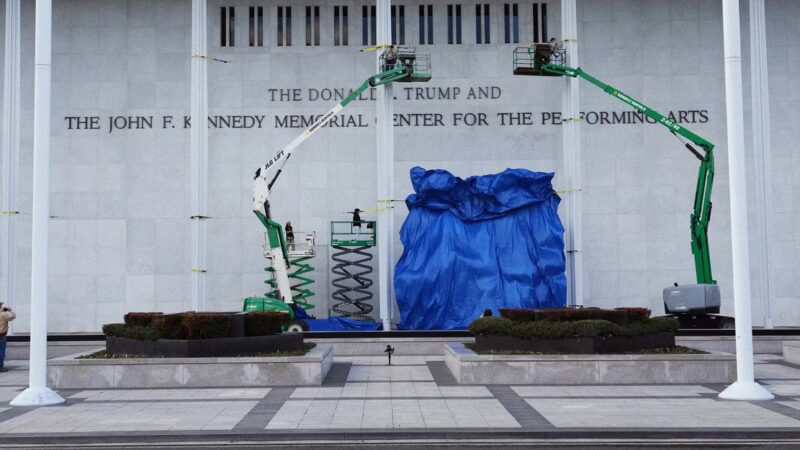
This belief follows more or less from every other decision Trump has made, which has collapsed the space between the president and the state. Trump can apparently give himself and his friends carte blanche to commit crimes, while deeming anybody who opposes him a criminal. He can turn the government into a propaganda arm, naming parts of it for himself and making the Army hold a parade on his birthday.
When his spokespeople claim there are no conflicts of interest, they are defining Trump’s actual theory of governing: L’état, c’est moi.